Google Ads: Connecting Your Business With People Who Are Ready to Act
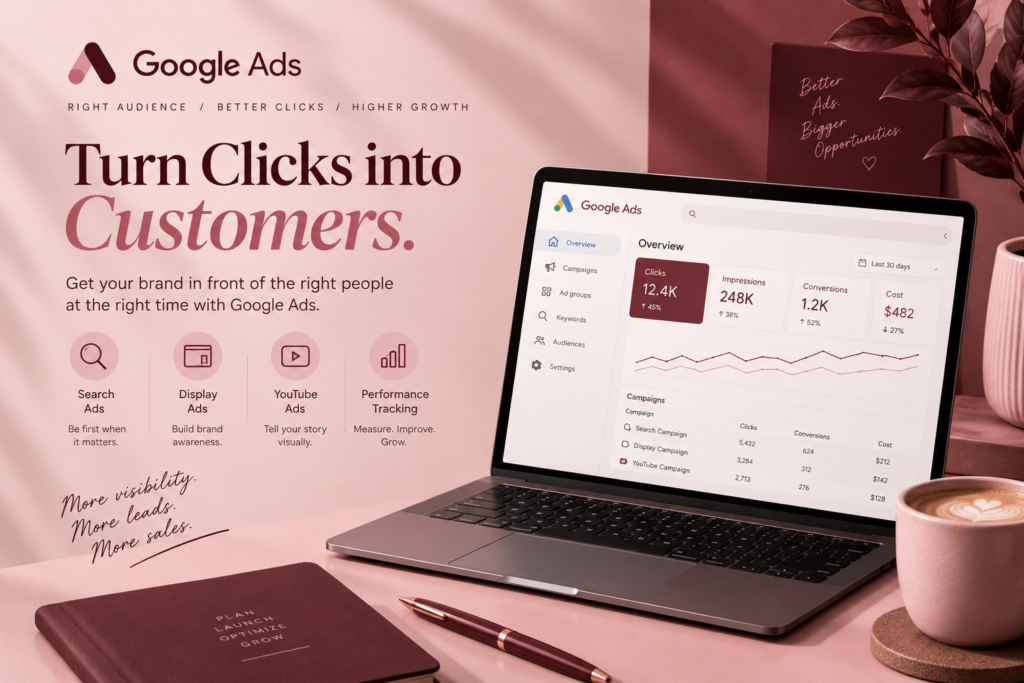
When people need a product, service, or solution, one of the first things they often do is search online. This creates a valuable opportunity for businesses to reach potential customers at the moment they are actively looking for something.
Google Ads helps businesses place paid advertisements in front of relevant audiences across Google’s advertising network.
Unlike strategies that depend mainly on building visibility over time, paid search can help businesses appear when potential customers are already searching for related products or services.
What Are Google Ads?
Google Ads is Google’s online advertising platform that allows businesses to create paid campaigns to promote their products, services, websites, apps, and more.
For example, if someone searches for “digital marketing services in Kerala,” businesses offering those services can use Google Ads to potentially appear prominently in the search results.
The goal is not simply to get more clicks.
The goal is to attract people who are likely to take valuable action.
Why Are Google Ads Important?
Google Ads can help businesses reach potential customers when they are actively searching for a solution.
A well-planned campaign can help:
- Increase online visibility
- Reach relevant audiences
- Generate website traffic
- Increase leads and enquiries
- Promote products and services
- Support online sales
- Reach customers based on specific search intent
- Measure advertising performance
This makes Google Ads especially useful for businesses that want to connect their marketing efforts with measurable actions.
How Do Google Ads Work?
Google Ads works through an advertising auction that determines which eligible ads appear for a particular search and where they are shown.
A simple campaign process can be understood as:
Goal → Research → Keywords → Ad Creation → Landing Page → Launch → Measure → Optimize
First, you define your campaign goal and understand what your potential customers are searching for.
Then, you select relevant keywords, create compelling advertisements, and direct users to a useful landing page.
After the campaign goes live, performance data helps you identify opportunities for improvement.
What Are Keywords in Google Ads?
Keywords are words or phrases that help connect your advertisements with relevant searches.
For example, a business offering SEO services might consider keywords related to:
- SEO services
- SEO agency
- SEO consultant
- Website SEO services
Choosing relevant keywords is important because the quality of your traffic often matters more than simply generating a large number of clicks.
Understanding Search Intent
Not every search means the same thing.
Someone searching “what is SEO?” may simply be looking for information.
Someone searching “SEO services for small business” may be much closer to considering a service.
Understanding this difference is called search intent.
A successful Google Ads strategy considers what users are actually trying to accomplish when they search.
Creating Effective Google Ads
A good advertisement needs to communicate its value quickly.
An effective ad usually includes:
Relevant Message + Clear Benefit + Strong Call to Action
For example, instead of using a vague message, an ad can clearly explain what the business offers and guide users toward the next step.
The message should also match the keyword and the landing page the user reaches after clicking.
The Importance of Landing Pages
Getting someone to click an advertisement is only part of the journey.
After clicking, users should arrive on a relevant, clear, and easy-to-use landing page.
A good landing page should:
- Match the advertisement
- Explain the offer clearly
- Be easy to navigate
- Load efficiently
- Work well on mobile devices
- Include a clear call to action
If the landing page doesn’t meet the user’s expectations, even a well-performing advertisement may struggle to generate conversions.
Different Types of Google Ads
Google’s advertising ecosystem includes several campaign formats designed for different marketing goals.
Search Ads
These advertisements can appear when people search for relevant keywords on Google.
They are particularly useful for reaching people who already have an active search intent.
Display Ads
Display campaigns can use visual advertisements across websites and other digital placements within Google’s network.
They can be useful for building awareness and reaching audiences beyond search.
Shopping Ads
Shopping campaigns help businesses promote products with useful product information, particularly for e-commerce.
Video Ads
Video advertising can help businesses reach audiences through Google’s video ecosystem, including YouTube.
App Campaigns
Businesses promoting mobile applications can use app-focused campaigns to encourage installs and other valuable actions.
The right campaign type depends on the business, audience, and marketing objective.
How Do You Measure Google Ads Success?
One of the biggest advantages of digital advertising is the ability to measure performance.
Depending on your campaign goal, important metrics can include:
- Impressions
- Clicks
- Click-through rate
- Cost per click
- Conversions
- Cost per conversion
- Conversion rate
- Return on ad spend
The most important metric isn’t always the number of clicks.
For a lead-generation campaign, for example, quality leads and cost per lead may be more valuable than simply increasing website traffic.
Why Optimization Matters
Launching a campaign is not the final step.
Google Ads campaigns should be monitored regularly to understand what is working and where improvements can be made.
Optimization can involve:
- Reviewing keywords
- Improving ad copy
- Testing different messages
- Adjusting bids or budgets
- Improving landing pages
- Analyzing search terms
- Refining audiences
- Reviewing conversion data
Small improvements over time can make a campaign more efficient and effective.
Google Ads vs SEO
Google Ads and SEO both help businesses appear in search results, but they work differently.
SEO focuses on organic visibility, while Google Ads focuses on paid visibility.
SEO is generally a long-term strategy that builds visibility over time.
Google Ads can provide faster opportunities to appear for targeted searches, but it requires an advertising budget.
For many businesses, using both strategies together can create a more complete search marketing approach.
Final Thoughts
Google Ads gives businesses the opportunity to connect with potential customers when they are actively searching for products, services, and solutions.
But successful advertising isn’t simply about spending more money.
It is about understanding search intent, choosing relevant keywords, creating useful advertisements, providing strong landing pages, and continuously improving performance.
When strategy and creativity work together, Google Ads can turn searches into meaningful opportunities for a business.
Be present when people search. Be relevant when they click. Be ready when they act.
But content creation is more than simply posting something online. Good content begins with an idea and turns it into something valuable for the right audience.
What Is Content Creation?
Content creation is the process of planning, producing, publishing, and improving content for a specific audience and purpose.
Content can take many forms, including:
- Social media posts
- Blog articles
- Reels and short-form videos
- Infographics
- Website content
- Email newsletters
- Educational guides
- Visual graphics
Although the format may change, the purpose remains the same: communicate a message that matters to your audience.
Why Is Content Creation Important?
People interact with brands through content every day. The content a brand shares can influence how people understand, remember, and connect with it.
A strong content strategy can help a brand:
- Build brand awareness
- Educate its audience
- Increase engagement
- Build trust and credibility
- Drive website traffic
- Generate leads
- Support conversions
When content consistently provides value, audiences have more reasons to follow, engage with, and trust a brand.
How Does Content Creation Work?
Creating effective content requires more than creativity. It also requires an understanding of the audience, the brand, and its goals.
A simple content creation process is:
Research → Plan → Create → Publish → Analyze → Improve
1. Research
The first step is understanding your target audience. What are they interested in? What questions do they ask? What problems are they trying to solve?
Research helps you discover topics and ideas that are genuinely relevant to the people you want to reach.
2. Plan
Once you understand your audience, decide what you want your content to achieve. Your goal might be to increase awareness, educate people, build engagement, or generate leads.
Creating content pillars can also help organize your topics and maintain consistency.
3. Create
Turn your ideas into the right content format. This could be a social media caption, carousel, blog, reel, infographic, or video.
The content should be clear, useful, engaging, and aligned with the brand’s personality.
4. Publish
Share your content on the platforms where your audience is most active. Consistency is important, but quality should always come before simply posting more frequently.
5. Analyze
After publishing, look at how your content performs. Metrics such as reach, engagement, clicks, saves, shares, and conversions can provide useful insights.
6. Improve
Use the information you collect to understand what works and what needs improvement. Content creation is an ongoing process, so every result can help make the next piece of content stronger.
What Makes Content Good?
Good content doesn’t have to be complicated. In many cases, effective content is simply:
Useful + Relevant + Clear + Authentic
The audience should gain something from it—whether that is knowledge, inspiration, entertainment, or a solution to a problem.
For example, instead of simply promoting a product, a brand can create content explaining how that product solves a customer’s problem.
This changes the focus from “What do I want to say?” to “What does my audience need?”
That simple shift can make content much more meaningful.
Different Types of Content
A balanced content strategy uses different types of content to keep the audience interested.
Educational Content
Educational content helps people learn something useful.
Examples: Tips, tutorials, guides, how-to posts, and industry insights.
Entertaining Content
Entertainment captures attention and encourages people to interact with a brand.
Examples: Reels, relatable posts, quizzes, challenges, and creative videos.
Inspirational Content
Inspirational content helps create an emotional connection.
Examples: Stories, achievements, motivational content, and customer journeys.
Promotional Content
Promotional content introduces products, services, offers, or new launches.
However, not every piece of content should focus on selling. Audiences are more likely to connect with brands that provide value beyond promotion.
The Role of Creativity
Creativity helps content stand out in a crowded digital space.
A strong idea, interesting visual, engaging headline, or unique storytelling approach can make people stop scrolling and pay attention.
However, creativity should support the message rather than distract from it.
Create to communicate, not just to decorate.
The best creative content combines visual appeal with a clear purpose.
Why Consistency Matters
One great piece of content can attract attention, but consistent content helps build recognition over time.
A consistent strategy allows your audience to become familiar with:
- Your visual style
- Your tone of voice
- Your topics
- Your values
- Your brand personality
Consistency doesn’t mean posting every day. It means maintaining a recognizable presence and delivering valuable content regularly.
Over time, this can help create a stronger and more memorable online identity.
Content Creation and Digital Marketing
Content creation connects with almost every area of digital marketing.
SEO uses valuable content to improve search visibility.
Social Media Marketing uses content to engage and connect with audiences.
Email Marketing uses content to build and maintain relationships.
Paid Advertising uses creative content to attract attention and encourage action.
Because of this, content is not just an individual marketing activity. It can become the foundation that supports a wider digital marketing strategy.
Final Thoughts
Content creation is more than creating something and putting it online. It is about understanding people, finding meaningful ideas, and communicating them in a way that creates value.
When content is useful, authentic, creative, and consistent, it can help a brand move beyond simply being visible online.
It can help a brand become recognized, trusted, and remembered.
Create with purpose. Connect with people. Grow with content.